
Wednesday, July 3, 2013
Mysteries of Modern Medicine: The HEAd Anastomosis VENture
Slate Magazine recently produced a short video titled "Who's Ready for a Full Head transplant?" The staff had a lot of fun with this, taking clips appropriately from Frankenstein ("He's alive! He's alive!"), Young Frankenstein (Marty Feldman playing Igor singing I Ain't Got Nobody), The Incredible 2 Head Transplant ("This Brain Wants to Love You, this Brain Wants to Kill You"). Dr. Sergio Canavero is the evil scientist here who even invents his own product, an inorganic polymer glue called "Heads On Glue". In attaching the new head, how could Dr. Canavero possibly get all the nerve connections working properly? With a slight toss of his head and the confident tone exhibited by all great neurosurgeons, he replied that "only few nerve connections need to be correct"!


Saturday, June 22, 2013
Jobs the Movie (No, it's not about US unemployment)
The video above is the trailer for the upcoming movie about Steve Jobs starring Ashton Kutcher and Amanda Crew with a large cast (here and here) out of Apple history (Jack Dudman, Mike Markkula, Steve Wozniak, John Sculley, Andy Hertzfeld, Gil Amelio, Bill Atkinson, Chris Espinosa, Jeff Raskin, etc.). If you've read Steve Jobs (the book), I think you'll find the movie very interesting, especially after seeing the trailer.
I have written posts about Steve Jobs (here) and hope to do more in the future. And, I can't wait to see the movie.
Sunday, June 2, 2013
What is Trackman and how is it changing golf?
Trackman is a phased-array dopler radar (the small, upright device behind the golfer in the video above, costs about $20K right now and is connected to a PC on the right) that provides detailed feedback on ball flight and club face measurement during a golf swing. Trackman is used for club fitting, golf training and analysis. The video above gives an excellent introduction to the device.
The first step in using Trackman is to pick a target line. Then, when you hit the ball, Trackman provides real-time flight tracking: ball speed, vertical launch, launch spin, carry distance, club speed, and hang time. Trackman also provides club measurement data: club path, club face angle, ball dispersion, attack angle (vertical movement), vertical swing plane, horizontal swing plane, and dynamic loft.

It's important to point out that Trackman does not make a movie of the player's golf swing. Slow motion analysis of golf video was the dominant technology for studying the golf swing. It led to proscriptions about how the golf swing should look and positions the arms, hands and body should be in at different points in the golf swing (see for example Tiger Woods My Swing app pictured above or the approach used by GolfTec and the analysis of my Stack and Tilt swing here, here, here, here, here, here, here, here and here). Trackman data has demonstrated that the two most important pieces of information are swing speed, face angle (closed, open, square), angle of attack (downward, level, upward) and swing path (in-out, out-in or square) at impact. Since different styles of golf swing can produce the same swing speed, face angle and swing path at impact, stylistic proscriptions are less important and potentially irrelevant. Another way to say this is that the ball knows nothing about your golf swing, either before or after it was hit.
Trackman is currently being used by golf professionals, club makers, club fitters and golf instructors. The data generated from trackman has changed golf training, golf instruction, club design and how those who use it think about the golf swing. I'll talk about all this in future posts.
DISCLAIMER: Trackman is not the only phased-array dopler radar launch monitor. There is also one made by FlightScope. Since I have not used either of these launch monitors, nothing I have said above or in other posts is meant as a product endorsement. Because Trackman seems to be the most popular, I will continue using "Trackman" as a generic name for "phased-array dopler radar launch monitors". There are also many launch monitors that are not radar based or use radar but not phased-array dopler radar (here). These launch monitors produce less information, have some reliability and accuracy problems but are more affordable.
TECHNICAL NOTE: FlightScope provides a nice technical description of how the phased-array dopler radar launch monitor works (here with a graphic below, click to enlarge). FlightScope has been successfully sued by TrackMan for patent infringement (here), so we'll have to see what the future availability of the product will be.

Wednesday, May 29, 2013
US Congress Fumbles Financial Reform
Why Financial regulation will never happen given the makeup of the US Congress (from Robert Kaiser's comments in the video): "...it was the belief that it ... [regulation]... was the wrong way to go held by people who didn't understand the situation."
Mr. Kaiser does not mention the role of money in politics and Upton Sinclair's comment (here) that "It is difficult to get a man to understand something, when his salary depends upon his not understanding it!"
Watch New Book Chronicles Fight Over Financial Reform After Crisis on PBS. See more from PBS NewsHour.
Tuesday, May 28, 2013
Don't Throw Your Love On Me So Strong
The great guitarist and Roy Plumb student, Lance Olson, passed on the video (above) and note (below) from the National Guitar Museum on T-Bone Walker (1910-1975), probably one of the last great blues guitar players to use a hollow-body, arch-top jazz guitar. T-bone, we miss you, RIP (I'm not sure why he got the name "T-bone" but his split below kind of looks like one)!
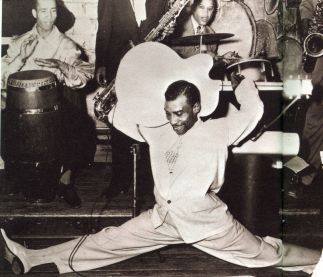
Aaron Thibeaux Walker was born on May 28, 1910 . . . 103 years ago. Nicknamed T-Bone, Walker learned the guitar at age 13, and recorded as early as 19. He was among the first blues players—if not the very first—to use the electric guitar as his instrument of choice. He claimed to have picked up an “electrified” guitar as early as 1935, making him one of the first electric guitarists in any genre. T-Bone put on a sensational live show, picking with this teeth and playing behind his head (something Jimi Hendrix would later do), doing splits and strutting (later done by Chuck Berry), and wrote one of the blues’ most enduring songs, “Stormy Monday” (or, as he called it "Call It Stormy Monday (But Tuesday's Just As Bad).” Here’s an incredible live version of “Don’t Put Your Love On Me So Strong.” Enjoy.
Wednesday, May 22, 2013
Stack and Tilt: The "Two" Standup Moves
In the video above, PGA professional Mike Bennett (co-founder of the Stack and Tilt Swing, S&T) gives New Zealand PGA professional Marcus Wheelhouse a lesson. Mike Bennet discusses a number of interesting issues here, but what caught my attention was his discussion of the two standup moves.
My basic swing thought in S&T has been: stack-tilt-standup. It turns out that there are actually two standup moves in the swing, one on the backswing and one on the follow through. Mike also mentions the reason for straightening the left leg and describes ground loading (squatting down and standing up on the second standup).
So, for all of us who would like a lesson from Mike Bennett, this is about as close as we'll get!
Subscribe to:
Posts (Atom)


